Publications
Publications by categories in reversed chronological order. Generated by jekyll-scholar.
2026
-
-
-
 Early Target Object Prediction in Action ObservationQuarterly Journal of Experimental Psychology, 2026
 -
 Explaining Neural Networks in Preference Learning: a Post-hoc Inductive Logic Programming ApproachTheory and Practice of Logic Programming, 2026
 -
 Non-monotonic Bounded ReasonersIn Logic & Cognition Conference (L&C 2026), 2026
 -
2025
-
 AI in the Experimental Loop: Implications for Replicability in Social Robotics and Social Sciences2025Preprint
 -
 A Graphical Formalism for Reasoning about Substitution in Resource Transforming ProceduresJournal of Artificial Intelligence Research, 2025
 -
 Checking trustworthiness of probabilistic computations in a typed natural deduction systemJournal of Logic and Computation, 2025
 -

-
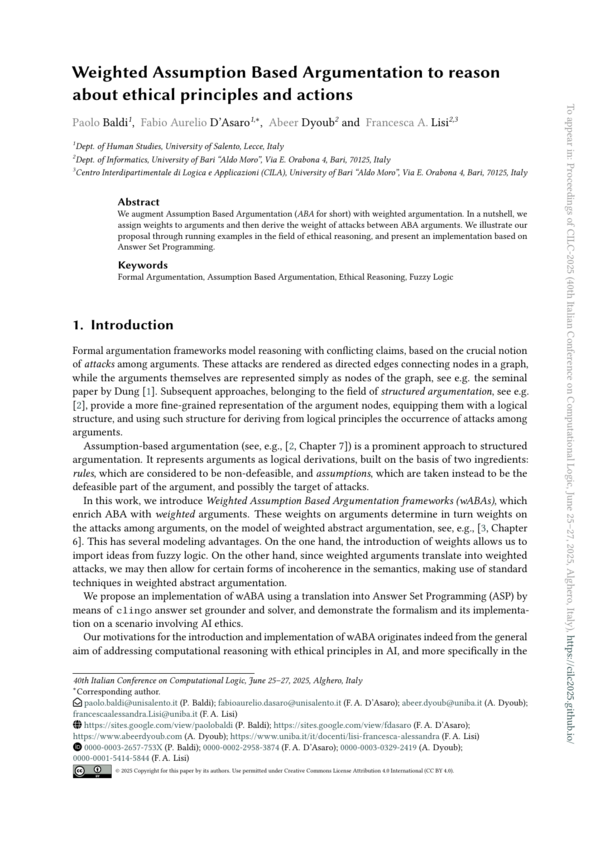 Weighted Assumption Based Argumentation to reason about ethical principles and actionsIn Proceedings of CILC 2025, 2025
 - CORE C
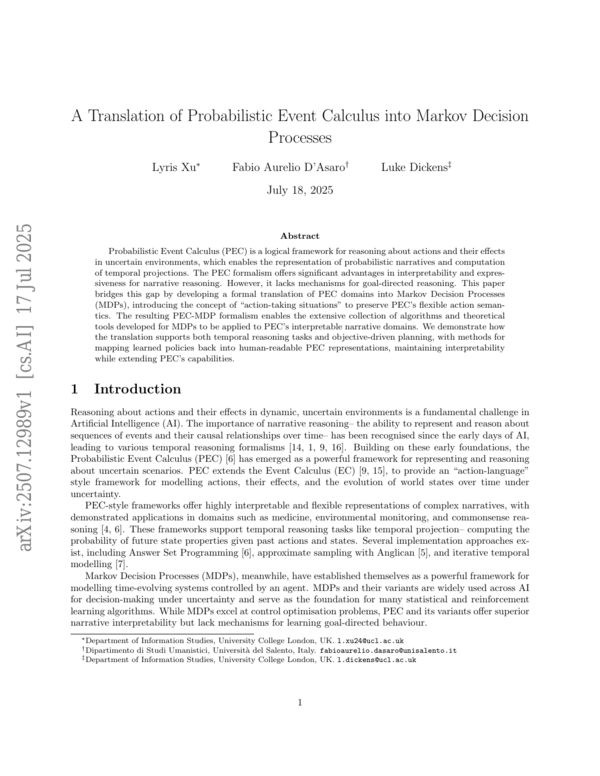 A Translation of Probabilistic Event Calculus into Markov Decision ProcessesIn Proceedings of TIME 2025, 2025
2024
-
 "Sensing" the future: From Kant to the brain as a predictor2024Preprint (ESS Open Archive / Authorea)
 -
 How can we conceive replicability with AI-mediated experimental conditions? A position talkIn Atti del Congresso AIP Sperimentale 2024, 2024
 -
 Educare all’IA. La sfida didattica dell’Intelligenza Artificiale: ChatGPT e Gemini2024ISBN 9791256030019
 -
 An Answer Set Programming-based implementation of Epistemic Probabilistic Event CalculusInternational Journal of Approximate Reasoning, 2024
2023
-
 Deep Reinforcement Learning for Robotic Approaching Behavior Influenced by User Activity and DisengagementInternational Journal of Social Robotics, 2023
 - An Application of a Runtime Epistemic Probabilistic Event Calculus to Decision-making in e-Health SystemsTheory and Practice of Logic Programming, 2023
-
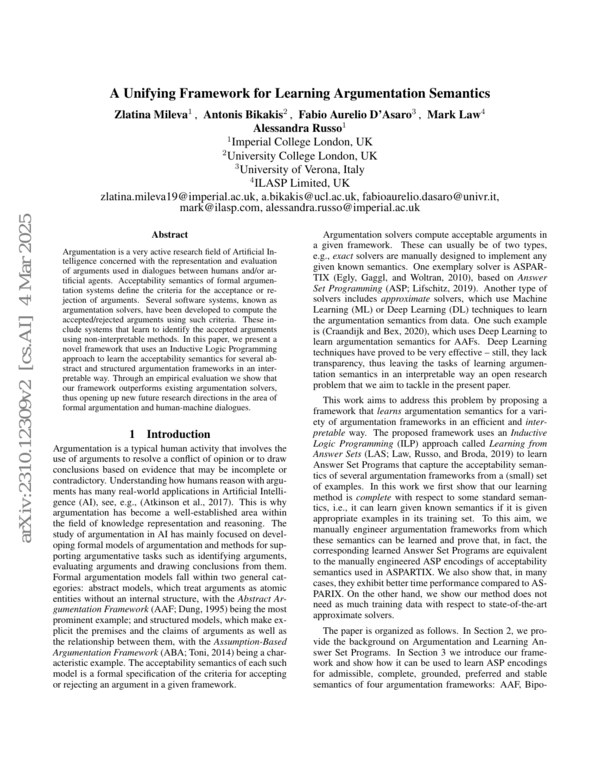 A Unifying Framework for Learning Argumentation SemanticsarXiv preprint arXiv:2310.12309, 2023
 -
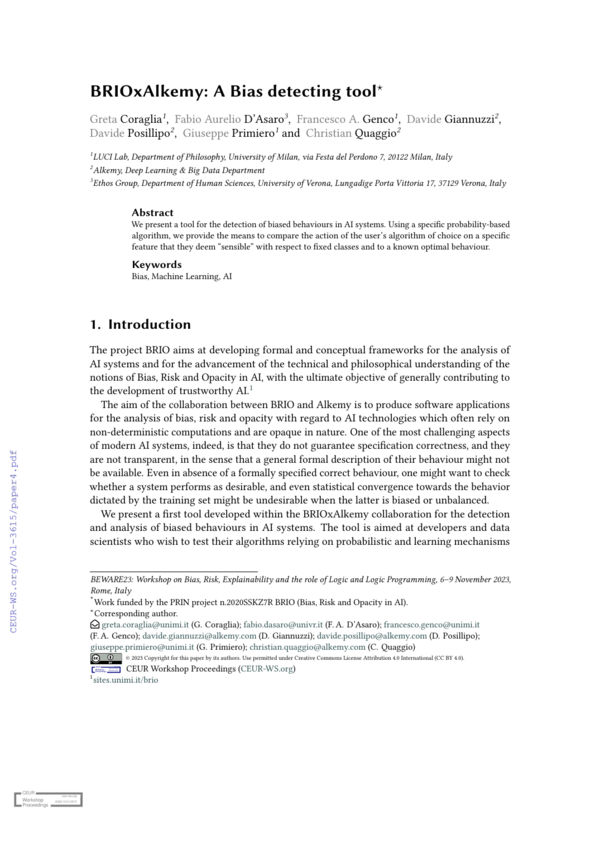 BRIOxAlkemy: A Bias Detecting ToolIn Proceedings of BEWARE-23 (AIxIA 2023), 2023
 -
 Advancing the Boundaries of Formal Argumentation: Reflections on the AI3 Special IssueJournal of Applied Logics, 2023
 -
 How do Decision Support Systems Nudge?In Proceedings of CEPE 2023, 2023
2022
-
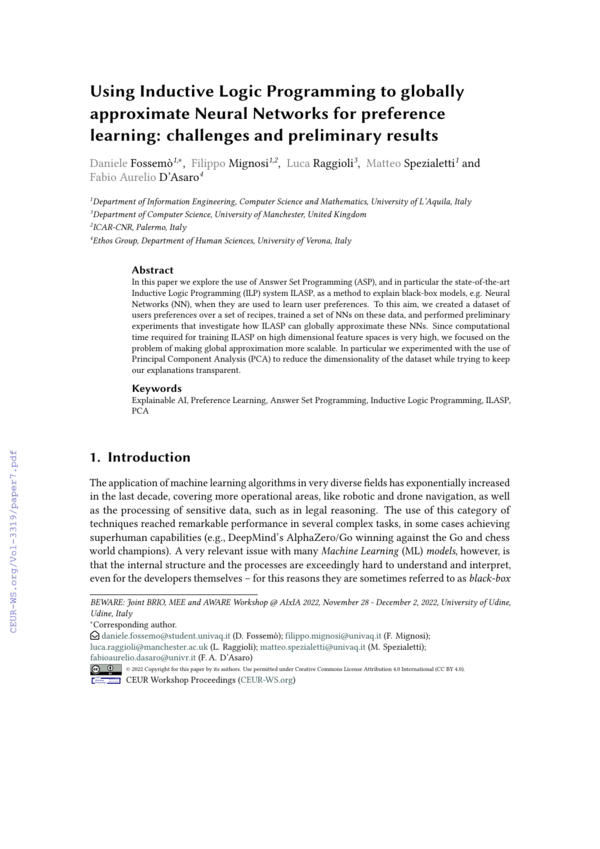 Using Inductive Logic Programming to globally approximate Neural Networks for preference learning: challenges and preliminary resultsIn Proceedings of BEWARE-22 (AIxIA 2022), 2022
 -
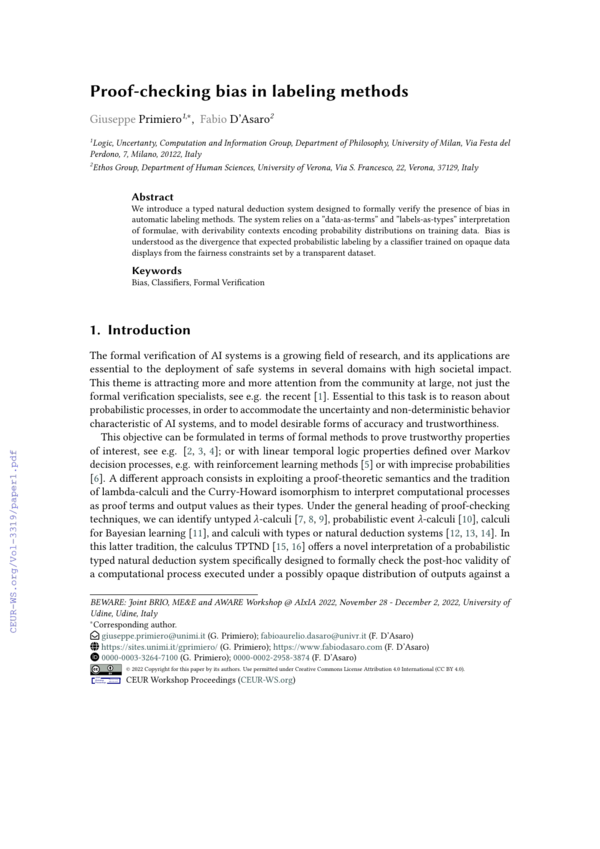 Proof-checking bias in labeling methodsIn Proceedings of BEWARE-22 (AIxIA 2022), 2022
 -
 Explainable artificial intelligence models and methods in finance and healthcareFrontiers in Artificial Intelligence, 2022
2021
-

- CORE A*
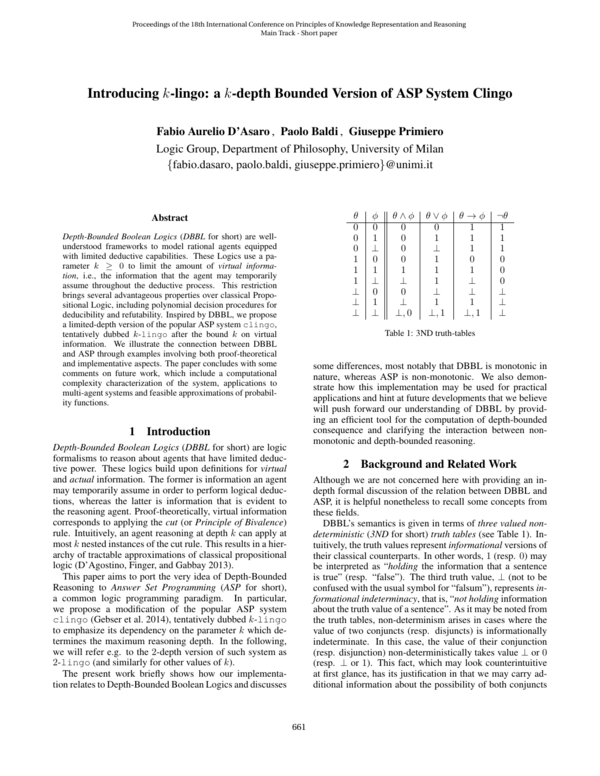 Introducing k-lingo: a k-depth bounded version of ASP system clingoIn Proceedings of KR 2021, 2021
 -
 Probabilistic Typed Natural Deduction for Trustworthy ComputationsIn Proceedings of the 22nd Int. Workshop on Trust in Agent Societies (TRUST 2021 @ AAMAS), 2021
 -
 Predicting humans: a sensor-based architecture for real time Intent Recognition using ProbLogIn Proceedings of WOA 2021, 2021
2020
-
-
 Administrating Cognitive Tests Through HRI: an Application of an Automatic Scoring System Through Visual AnalysisIn Proceedings of ICSR 2020, 2020
 - CORE A*
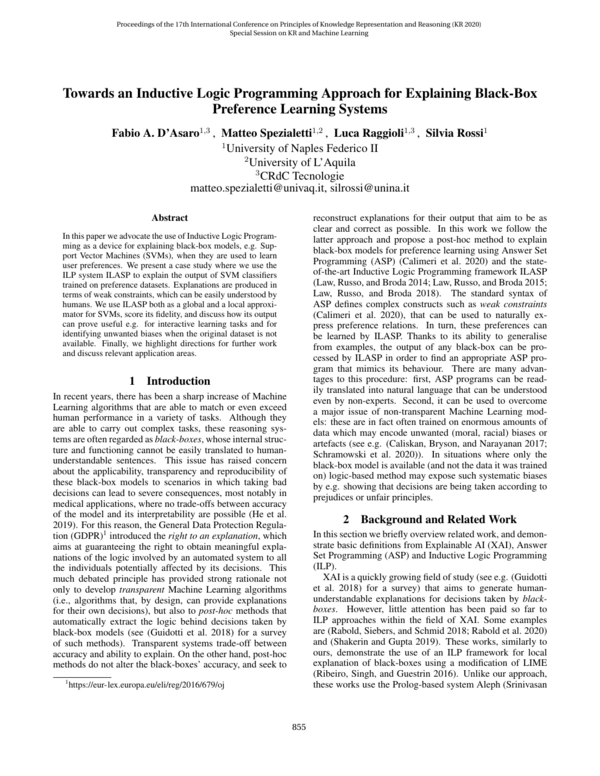 Towards an Inductive Logic Programming approach for explaining black-box preference learning systemsIn Proceedings of KR 2020, 2020
2019
-
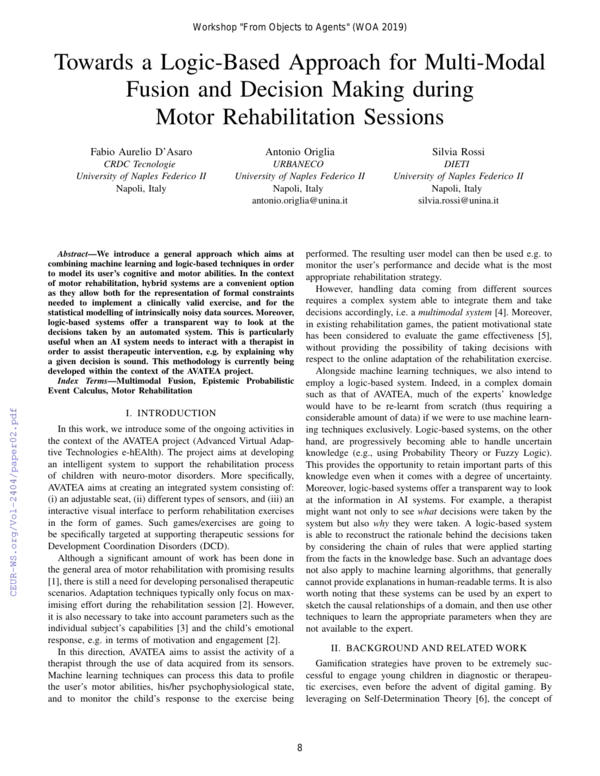 Towards a Logic-Based Approach for Multi-Modal Fusion and Decision Making during Motor Rehabilitation SessionsIn Proceedings of WOA 2019, 2019
2017
-
 Computational Intelligence and Citizen Communication in the Smart CityInformatik-Spektrum, 2017
 - CORE B
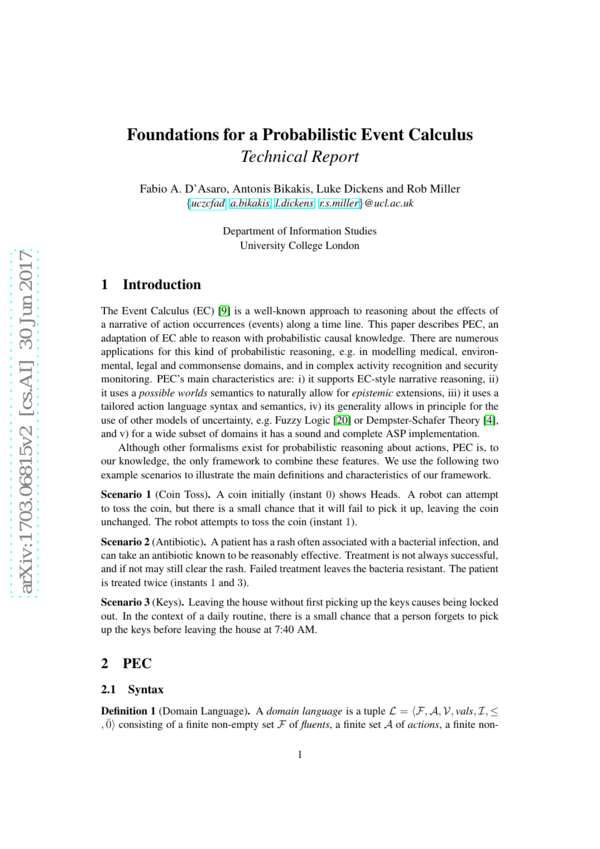 Foundations for a Probabilistic Event CalculusIn Proceedings of LPNMR 2017, 2017
2016
-
 A Note on Carnap’s Continuum and the Weak State Description Analogy Principle2016Unpublished
2015
- CORE B
 Agents Displacement in Arbitrary Geometrical Spaces: An Evolutionary Computation based ApproachIn Proceedings of ICAART 2015, 2015
2014
-
 L’obiezione di una Lady ed il computer che vince ai telequizIn flessibilMENTE: un modello sistemico di approccio al tema della flessibilità, 2014
2013
-
 Reflections on Technology and Human Sciences: rediscovering a common thread through the analysis of a few epistemological features of fuzzinessArchives for the Philosophy and History of Soft Computing, 2013
 - CORE C
 A fuzzy methodology to alleviate information overload in eLearningIn Proceedings of EUSFLAT 2013, 2013
 - CORE C
 Technology and human sciences: a dialogue to be constructed or a common thread to be rediscovered?In Proceedings of IFSA/NAFIPS 2013, 2013